Andalucía has always felt like one of those places made for road trips. The landscapes roll out in front of you, changing from olive groves to mountain passes to dramatic cliffs in the space of a couple of hours. Whitewashed hill towns cling to the edges of valleys, Moorish palaces dominate the skylines, and in between there are miles of winding roads that make you want to keep driving just to see what’s around the next bend.
I’ve visited Andalucía many times in the past, but I’d never done a road trip there and I love to drive abroad. It’s amazing the amount of scenery you’ll see in just a couple of hours from olive groves, to mountain passes, dramatic bridges and cliffs. You’ll pass countless whitewashed hill towns that are clinging to the edge of valleys, Moorish palaces and endless winding roads to keep you entertained (or hyper-alert!) for hours on end.
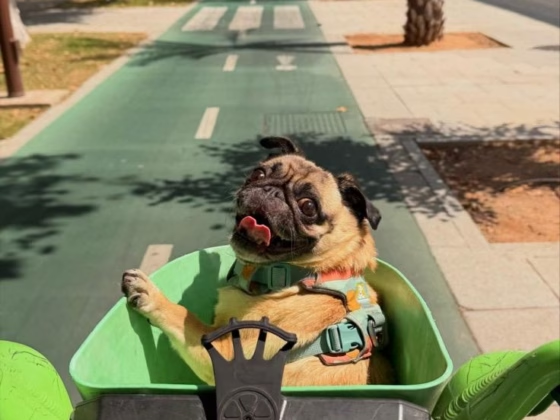
This time though, I wasn’t travelling alone. I had my dog with me, which adds a different layer to a trip like this. Travelling with a dog in southern Spain is absolutely doable, but it requires more thought. You can’t just wing it and hope for the best. You’ve got to plan the heat, the stops, the cafés, the hotels. It’s not the same as flying solo with nothing but a rucksack – but then again, it’s infinitely more rewarding when you’re sitting in a plaza with a coffee and your dog snuffling happily under the table (because she’s awaiting her next serving of chorizo iberico).
I based myself in Seville (you can read my trip report, here), rented a car, and set out on a fast-paced two-day loop through Ronda, Málaga, Frigiliana, Granada and Montefrío before heading back. It was ambitious, it was exhausting, but it was also some of the best scenery and most memorable towns I’ve visited in Spain.
[mobile-toc]Travelling Andalucía with a dog
Before diving into the route, here are some practical things I learned about having a dog with you in Andalucía:
- Packing smart: Don’t underestimate how much water your dog will drink in the heat. A collapsible bowl, a couple of bottles of water and even a little cooling mat if you have one are essentials. I also bring a blanket that smells like home, which helps my dog settle in new places.
- Car rules: Spanish law says dogs need to be restrained in the car, either with a seatbelt harness or in a crate. I just brought along the crate that she uses for flying.
- Stops: Service stations often don’t have grass or shaded areas, so I tried to time my breaks in towns or viewpoints where there was space for a quick walk. You definitely want to be stopping every 30-45 minutes or so. Although, it depends on your dog’s temperament. My dog can handle a 12-hour flight, but 30-minutes in a car is hell on earth. I’ll never understand it!
- Accommodation: Most family-run hotels and Airbnbs are fine with dogs, but always confirm ahead of time. “Pet friendly” can have different meanings, so make sure you check ahead.
- Sightseeing reality: Dogs aren’t allowed inside headline attractions like the Alhambra. If you’re on your own, you’ll have to accept you’ll miss some of the major sights. For me, that was fine. I focused on the plazas, the side streets and the views – the places my dog could enjoy, too.
The route
Day 1 – Seville to Ronda to Málaga
I set out early from Seville, coffee in hand, with the car packed and the dog tucked into her travel crate. The drive to Ronda is about two hours, mostly on decent roads with olive groves stretching as far as you can see. I pushed straight through, but if you have more time it’s worth pulling off at Zahara de la Sierra. The village sits on a hill overlooking a turquoise reservoir and it looks like it’s been painted onto the landscape. It would have been a perfect place for the dog to stretch her legs, but I had a busy day ahead, little time and the midday heat to think about.
 Ronda
Ronda
I parked at Parking Poeta Rilke. It’s not right in the centre, which is exactly what you want. Less stress, plenty of spaces, and you avoid having to navigate the chaos of Ronda’s tourist-packed streets. From there you can walk along the Paseo de los Ingleses, a shaded promenade lined with trees that looks out across the gorge. There are a couple of miradores along the way – the Mirador de Ronda and the Mirador de Aves – which give you some of the best views without needing to battle through the crowds at the main bridge. It’s the perfect route to get into the middle of town with the dog.
Before heading for the gorge, I stopped for a coffee nearby at BlackCoffee. They’ve got tables outside, so I sat with the dog under an umbrella. It’s a sun trap otherwise, and you don’t want to be frying while you sip your flat white. From there it’s only a short walk to the main attraction: El Tajo de Ronda. The gorge is every bit as dramatic as you’ve seen in the photos, and the Puente Nuevo bridge that spans it is the centrepiece. It’s free to visit but it does get rammed with tourists, so keep your dog close. My dog, Bella, is tiny, so in spots like this, she goes under the arm.
If you’ve got more time, Ronda has plenty below the surface, quite literally. Down in the gorge itself you’ll find the Jardines de Cuenca and a few little trails that wind their way closer to the bridge. I wish I’d been able to do them properly, but with a pug and a midday sun overhead, it just wasn’t happening. In hindsight, I’d spend a night in Ronda, leave the dog in a cool hotel room, and give myself time to explore it properly.
 Málaga
From Ronda it’s about 1 hour 45 minutes on twisting mountain roads down to Málaga. By the time I rolled in it was evening, and unfortunately the city didn’t win me over. Maybe it was bad timing – there was some sort of festival happening – but it felt like fifteen Ryanair flights from northern England had landed all at once. The old town was packed, loud, and not the kind of energy I wanted after a long day.
That said, I did find a fantastic dinner spot. La Ristobottega is an Italian restaurant tucked away in a plaza right next to the cathedral. The food was great, the setting was beautiful, and best of all, they were more than happy to have the dog with me outside. If you’re heading to Málaga, I’d say book accommodation with parking, because finding a space here was a nightmare.
Day 2 – Málaga to Granada (via Frigiliana), then back to Seville
I started the day with breakfast at Mi Cafecito, a small dog-friendly café in Málaga that was exactly what I needed before getting back on the road. From there it was about a 45-minute drive east to Frigiliana.
Frigiliana
Frigiliana is one of those towns that looks like it was designed for Instagram, one of Spain’s most famous white-washed towns. Narrow cobbled lanes, flowerpots on every wall, and endless whitewashed houses tumbling down the hillside. I parked in the Frigiliana Public Parking – Aparcamiento público, which was cheap (under €5 for the morning) and underground, so the car stayed cool. They’ve got a clever light system above the bays to show where spaces are free, which saves circling endlessly.
I stopped at Caravansar Coffee for a sandwich and a quick espresso. It’s tiny, with only one outdoor table squeezed onto a narrow pavement, so it’s not the most comfortable with a dog. The staff had that slightly weary air of people who’ve dealt with too many tourists in one morning, but the food was fine and the location worked. From there I wandered up into the centro histórico. The streets are mostly pedestrianised, which makes it great with a dog, and there are plenty of cafés with outdoor seating. Just remember the stone streets heat up fast – by midday they’re scorching, and you’ll need to protect your dog’s paws.


Granada
 After Frigiliana it was around an hour and a half to Granada. The city is undeniably beautiful, but also intense. It’s hilly, crowded, and in summer the heat bounces off every stone surface. If your dog is small enough to carry, you’ll be fine. Mine, being roughly the size and weight of a baked potato, ended up in my arms more than once.
For lunch I headed to Restaurante Carmen de Aben Humeya, which has one of the best views of the Alhambra you’ll find anywhere. It’s billed as one of the most romantic restaurants in Europe, which I’m sure is true if you’re not sitting alone with a panting pug. The food was excellent and the staff were friendly, but the heat was relentless. The terrace was unusable in August and the indoor air-con barely made a difference. Still, it’s worth it for the view. Later, I stopped at Alhambra Churrería for churros. Yes, it’s touristy and overpriced, but sometimes you’ve just got to embrace it. You can sit outside with your dog and it’s a good excuse to rest your legs.
Montefrío
By late afternoon it was time to head back towards Seville, but I broke up the drive with a stop in Montefrío. This little town was once ranked by National Geographic as having one of the top ten views in the world, and I can see why.
The castle dominates the skyline, perched on a rocky outcrop, like something out of a medieval cinematic epic. It’s only open for a few hours in the late morning and again in the late afternoon, so check your timing. Entry costs just a couple of euros and dogs are allowed, which makes it an easy stop. The drive up is steep and nerve-wracking, with hairpin bends that had me gripping the wheel, but once you’ve parked it’s only a five-minute walk. Inside, there’s a short video that explains the history, which I actually found interesting. Give yourself at least an hour to explore.
On the way out of town, stop at the Mirador National Geographic. You’ll pass it anyway as you head back towards the motorway, and the view is every bit as impressive as the hype. From there it’s about two and a half hours back to Seville, mostly along the A-92 motorway.


Tips for a smooth dog-friendly road trip
- Time your walks: Early mornings and late evenings are the only safe times in summer. Midday heat is brutal.
- Book accommodation with parking: Especially in cities like Málaga or Granada where street parking is impossible.
- Take it slower if you can: Two days is rushed. With three or four you’ll have more time to enjoy each stop.
- Mind the paws: Cobbled and stone streets get scorching hot. If your dog can’t be carried, you’ll need paw protection.
- Stay flexible: Festivals, traffic, or even just the weather will change your plans. The best moments often come from the detours.
Final thoughts
This two-day loop through Andalucía was ambitious, sometimes stressful, and at times too hot for comfort. But it was also unforgettable. From the cliffs of Ronda to the chaos of Málaga, the charm of Frigiliana, the views of Granada, and the dramatic views of Montefrío, it packs an incredible amount into a short space of time.
Travelling with a dog means you see a different side of these places. You skip the museums and monuments, but you gain long walks along shaded paseos, hours sitting in plazas with coffee, and the kind of slower moments that make a trip feel lived-in rather than just ticked off.
If you’re based in Seville and you want to see some of the highlights of Andalucía without committing to a long trip, this route is one of the best ways to do it. Just be prepared for the heat, for the driving, and for carrying your baked-potato-shaped sidekick when the cobbles get too hot.