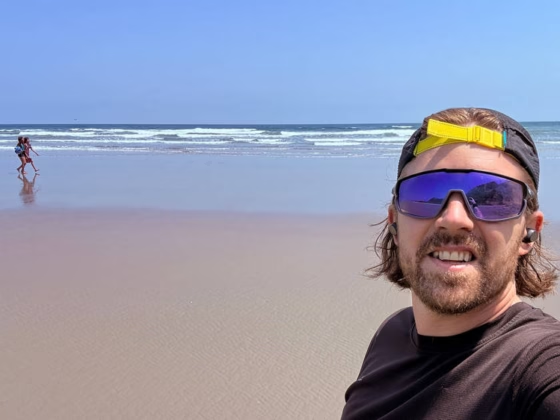
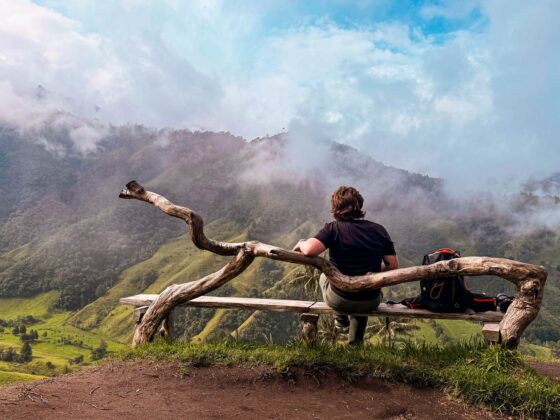
This month I’m reaching my one-year milestone on the road and it’s been quite the journey, a lot of highs and a lot of lows. At the same time, I’ve recently just acquired my digital nomad visa, my final “goal” of this journey I started a year ago. And what better way to celebrate than with a romanticised recap of the past twelve months…
Table of Contents
- Chapter 1 – The rug pull
- Chapter 2 – Mexico: the first love
- Chapter 3 – Central America: the vibe check
- Chapter 4 – Colombia and the shortlist
- Chapter 5 – E‑Residency and the real relaunch
- Chapter 6 – The holiday from the holiday that changed everything
- Chapter 7 – The stealth return
- Chapter 8 – The Ecuador digital nomad visa saga
- Chapter 9 – Bella’s passport
- Chapter 10 – Looking forward
Chapter 1 – The rug pull
You can tell yourself you’re prepared for anything, but the truth is, most curveballs don’t announce themselves. Mine was a slow burn that, in hindsight, I could see coming, but when you’re backed into a corner in the heat of the moment, it’s not quite as obvious.
Rewinding to January 2024, I was sat on a little boat cruising along Lake Titicaca in Peru. It’s home to the Uros (or Uru) an indigenous people of Peru and Bolivia that live on a network of floating islands. A fantastic experience but something stuck with me as I sat talking with my host, Caesar.
He pointed to this brightly coloured yellow boat on the horizon, “Our people board the dating boat in their early to mid-teens, and that’s how they meet their life partner.” He continued to muse about life on the islands and concluded, “Only around 5% of the population ever leave the islands for life on the mainland.”
That’s f*cking weird, I thought to myself.
And then, the penny dropped.
Caesar had just described to me how the population of these islands tend to marry young and spend their entire lives here. And whilst I have no doubt it’s a wonderful life for those affected, it became one of the most unappealing ideas I’d heard on my travels, probably only second to “do you want to try guinea pig for lunch?”.
I realised this very way of life was very similar to life in my hometown… a network of islands where the population marry young and don’t tend to leave. Well, that just about did it.
Of course it wasn’t solely that, I’d been dreaming about leaving my home island for a couple of years by this point, I just didn’t know how. But this conversation was the final trigger that told me I had to get my butt in gear. With that, I spent the next few weeks of my trip planning how I could break free and create a remote life for myself and realised I had three obligations/responsibilities in my life (lucky me, I know); my dog, my mortgage and my job. I broke them down into three separate projects and hyper-focused on them one at a time, a 20-hour bus journey was actually exactly what I needed.
In short;
- I figured out how I could bring my dog along for the journey—I’ll cover this in an upcoming blog.
- I decided I’d sell my property—there’s no way I’m dealing with tenants whilst I’m thousands of miles away
- and I put a plan together to convince my employer to let me work remotely for them
On point three, I presented my case to my employer and then gave them three months to decide either way. If it was a no, I’d respectfully hand in my six-month resignation, so I could give myself time to build up a company and go back to freelancing. In total, I’d given myself a timeline of 9 months to get this done, one way or another.
Fast-forward a few months and we were pretty good to go; paperwork was prepared for my dog, flights were booked, house was sold and after countless meetings and a trial period in Morocco, my employer had agreed I could work remotely.

But something didn’t feel right, after everything was verbally approved I was faced with weeks of silence and inaction, whilst I sat waiting for a contract. I couldn’t take my original freelance route as I was under my contractual obligation with my employer and I couldn’t get a signed contract from my employer to go remote either. I was trapped and the clock was ticking. With mere weeks to go, more and more questions arose, things started feeling off and sure enough: nine months on and literally days before my outbound flight, they formally pulled the plug on everything. “You’ll always have a job here in Guernsey” were the words that rang through my head as I tried not to break-down in front of them. Simply put, my life had just been ruined and I had a front seat to the whole fiasco. With no family to fall back on, soon to be homeless as my apartment proceeded through court and, at the time, zero financial security; I was screwed six ways from Sunday, to put it lightly.
Even a year on, I look back at this period in my life as I write this post and I’m beyond words. You read these horror stories about twisted employers but you never think you’ll end up working under them.
With the deathblow delivered, I took my final week to desperately and quickly figure out a plan B whilst my employer badgered me to make a hurried decision (the irony) given this new news: stay put or… well… or else. But, long story short, once my property sold and the money hit my bank account, I realised I was secure and I walked out and never looked back.
As I walked out of court, I entrusted the care of my dog to a close friend who stepped in at the last minute to support, so I could just figure out what on earth I was going to do.
And with that, a few hours later, I was on my way to Valencia. My life was now a 20‑kilogram backpack, with one storage suitcase left behind and a head full of possibilities (and anxiety… lots of anxiety).
The first week in Valencia was a blur of Spanish school classes, wandering the city and trying to ensure I was asking for a coffee “to go (llevar)” and not “to arrive (llegar)”. My diary from that week reads:
“Monday: unpacked, explored the neighbourhood, found a local bakery. Tuesday: bike ride through Turia Park, Spanish class in the morning, paella for lunch. Thursday: sang karaoke badly, drank too much Aperol, ended up sitting outside a bar eating peanuts at 1 am.”
I’d gone from rigid corporate routine to this, and I wasn’t looking back. I took October as more of “a career break” more than anything. My mental health was the lowest it had been in probably a decade and I was sure as hell not launching a company or applying for a job any time soon. I’d left my home of 30 years on the worst note imaginable, hurried out like a fugitive on the run – I needed this month to just recover mentally and figure out chapter two.
Continues below 👇


Chapter 2 – Mexico: the first love
After a month of decompressing in Valencia, I was ready to get on the move again and I decided that I’d follow “the gringo trail” which is basically working your way south from Mexico, until, well, you’ve had enough. I knew from the start that I wanted to be based in Latin America for the next couple of years, so I figured I would spend the next few months striking a balance between building a business and really travelling, like maybe for a year. I’d never done it properly, this was finally my chance.
I’m not sure what I expected of Mexico before I got there, but for most of us, we only understand Mexico through American media and it’s either the party scenes of Cancun or the dusty dangerous Cartel areas that look like something out of Breaking Bad – and there’s no in-between.
But what I didn’t expect, was to find one of the most beautiful and underrated countries I think I’d ever stepped-foot in. I ended up spending months in Mexico and everybody I met along the way said the same thing: Mexico surpassed all expectations. I expected colour, noise, tacos on street corners and maybe a few pretty colonial plazas. And yeah, I got all that. But I fell for Mexico, hard. It’s no surprise that Mexico is on track to be the fifth most-visited country in the world by 2030.
The country has this rhythm that’s at once chaotic and unhurried. The buses don’t run on time, but nobody’s in a rush to go anywhere. A conversation at a food stall might last 10 minutes longer than you meant it to, because people are just… like that.
And life just happens outside. It’s nothing to do with the weather either… people are just outside. Brits spend their entire life in an office or at the pub and when it’s sunny? They sit outside the pub. But Latin America? Everything happens outdoors, come rain or shine. That little fact is still my favourite thing about life on this side of the world.
I visited over 20 cities and towns in México, it wasn’t actually on my list but I thought, surely there will be a city here that will float my boat long-term. I tried Mexico City, Oaxaca, Guadalajara, Puerto Escondido – all of the usual nomad hotspots. But honestly? They just pissed me off. It’s not real life. They’re great for a holiday, they’re fantastic cities to visit don’t get me wrong, but did I want to live in one of these cities for six months in some nomadic bubble, where the cafés are overflowing with crypto bros on laptops? Hell no.
Then, on my last stop in the east of Mexico I found, Mérida. One evening I was walking through a park as the sun set, families outside, a Mayan re-enactment of pok-ta-pok in the square (thankfully, no ritual sacrifice at the end) and I just knew. This is it—this is the place.
It wasn’t just pretty either. It was practical in all the ways that mattered to me: walkable streets, a sense of safety after dark, a food scene that could keep me entertained for months and a pace of life that made it easy to blend in. Mérida became my benchmark city, the one every other stop on the trip would be measured against.
That experience was what helped me to start forming goals, a north star if you will. Goal number one: I need to find two cities in Latin America that I find suitable for long term living: I want green spaces, I want to hike, I want to run, I want good food, I want modern cafés and I don’t want it to be absolutely obliterated by rampant tourism. Mérida was safely at the top, and only, spot for now.
Continues below 👇


And in the middle of all this, I launched my marketing consultancy Edward and James. It was November. I was still figuring out my travel rhythm, juggling Spanish lessons and sightseeing with work, and somewhere in there I thought, yeah, let’s launch a business, I’m not going back to working for somebody again. I did actually try applying for a handful of jobs at this point, I found a few remote marketing positions but… I dunno… I’d just had enough of the corporate bull: the KPIs, the endless meetings, the rigid 40-hour workweeks, the quarterly reviews, the politics.
So yeah, I took the decision to launch something of my own, but it completely flopped. No calls. No clients. No traction. Crickets. A website I wasn’t proud of and a brand I hope never sees the light of day again. In hindsight, I’d thrown it together without giving it the time, focus or strategy it needed. I think I was still in a state of panic, 2-3 months on from the trauma of chapter one. But at the time, it really hurt. You don’t daydream about your first launch ending in tumbleweeds.
Still, the experience of Mexico, and more specifically Mérida, softened the blow. At least I was one step closer to finding “home” and ticking off goal number one. But, without income, this was all nothing but a pipe dream.
Goal number two? Build a business and get to profitability (i.e. cover a salary for myself) in the next six months.
I stayed over a month in Mexico, letting the country work its way into my bones (and unfortunately, into my love handles too). It was the first time on the trip I’d slowed down enough to feel settled, even without a permanent address. And when I eventually packed up to leave, I wasn’t ready. Which is probably the best sign a place can give you, right?
Chapter 3 – Central America: the vibe check
If Mexico was a love story, Central America was… an awkward second date. The kind where you try to convince yourself you’re having a good time, but the chemistry just isn’t there.
From the moment I crossed the border into Guatemala, it felt different — not bad, exactly, just not really my cup of tea. Guatemala is super-cool don’t get me wrong. Volcanoes looming in the distance, markets spilling over with colour and chaos, women in traditional huipiles balancing baskets of fruit on their heads like it’s nothing. But the whole “colonial city vibe” gets boring, fast.
I’m definitely in a minority, Central America is a must-see part of the world but I just couldn’t get along with it. After a month in Guatemala I made my way south to El Salvador from there I was going to cross to Nicaragua, Costa Rica, Panama and eventually, back to South America.
El Salvador was next. It’s a country that’s been working hard to shift its reputation, and parts of it have a real spark. I started in Santa Ana with no real plan of what was next, but this repeated colonial architecture and copy-cat cuisine was really starting to take its toll.
I decided that, for whatever reason, this wasn’t going to work for me and rather than waste more time and money trying to make something fit, it was time to say goodbye to Central America and head straight down to South America, my happy place. I’ll definitely go back to Central America, but in the capacity of a traveller, not as somebody looking for a spot to live slowly as a nomad (a slowmad, as the kids say).
Continues below 👇


I headed south to San Salvador the capital and got straight onto a flight to Bogotá in Colombia and as I boarded, I knew two things for certain:
- Central America wasn’t going to be my long‑term base.
- I needed a reset — somewhere I could just chill out for a while without constantly working around logistics.
It may seem that all of this has been quick and easy but between this sentence and the beginning of the blog, six months have passed. I’m shattered 😂
That reset was waiting for me in Colombia.
Chapter 4 – Colombia and the shortlist
Oh it was good to be back. Some countries greet you politely and ease you in; Colombia picks you up in an Uber at 2am who proceeds to try and ram somebody off the bridge for cutting him off at a red light. Oh yes, Colombia we are back.
I’d been to Colombia before, but only to Medellín (loved it) and Cartagena (hated it). This time I wanted to see more of the traditional side of Colombia but first off, I had to sample the capital that is Bogotá. Bogotá is kind of like, if you took London and stuck it in the middle of LATAM: You will 100% have your phone stolen, the weather is terrible most of the year but it’s a damn good craic if you love a big city and sinking pints.
I spent a week in Bogota and I really liked it, I don’t think I could do it long term; the safety concerns and the crap weather would drive me nuts eventually.
So I decided to train ChatGPT to help me find cities that I’d like, I fed it weeks of diary notes, told it all about Mérida, told it how I was a grumpy old man stuck in a 30-year old body and that as long as I can find a pistachio croissant and an Aperol Spritz nearby then I’ll be happy.

Go forth to Bucaramanga my young apprentice. Yeah, I dunno why it talks like a Star Wars character either, but, Bucaramanga it was.
Oh ChatGPT, you clever little sausage, I thought. This city was incredible. I describe Bucaramanga to people like it’s Medellín without all the stag dos (bachelor parties). The City of Parks, as it’s known, had streets lined with trees, long sunny days and packed full of some of the friendliest people I’d met on my travels.
It’s not somewhere I’d recommend for a holiday, there’s not enough going on in that department. But it’s a modern city without feeling soulless. I could walk to a café in the morning, work for a few hours, then stroll to a park without having to cross six lanes of traffic. The coffee shops were exactly my kind of vibe: big coffees, pastries-a-plenty, outside spaces and many encouraged co-working, too. If you’re interested, my trip report for Bucaramanga is here.
Somewhere between my second latte and my third arepa, Bucaramanga slipped comfortably to the top of my mental shortlist. This was definitely a “Could I… move here?” moment.
From there, I went back to Medellín, expecting to feel like it was a reunion with an old friend. Last time, I’d been swept up in its energy: the digital nomad scene, the endless events, the rooftop bars. This time… not so much. The city hadn’t changed, but I had.
Soooo deep, I know.
I realised pretty quickly that the coworking‑space‑by‑day, networking‑event‑by‑night lifestyle wasn’t for me. It felt performative. Like being part of an ongoing audition for “Most Interesting Remote Worker” when all I wanted was to quietly get my work done and then explore a place on my own terms. I’m old‑fashioned like that (read: miserable old git), give me a quiet café, my own space and a local rhythm over a “nomad hub” any day.
It was in Medellín, ironically, that Edward and James got its second life. I’d already flopped the first launch in Mexico, but this time I went all in. I spent money I’d been hesitant to spend before. I got help from people who knew exactly how to take my scattered ideas and turn them into something sharp and client‑ready and I worked with some top-notch freelancers to fill in my skills gaps – the same top notch freelancers I have been using for my own employers all these years… why didn’t I deserve the same quality of talent, right?
We rebranded. We rebuilt the website from scratch. I refined the services so they actually matched what I was best at, rather than trying to be this bright and colourful marketing brand like everybody else, I doubled down on strategy and my qualifications. And then, sure enough, it started to work. The first new client. Then the second. Enough to pay the bills, enough to prove this could be more than a travelling side project.
By the time I left Medellín, I had a clear vision: a shortlist of cities I could see myself in, and a business that could fund it. That was it, I’d finished, basically (we’ve still got six more chapters though, buckle in).
And with that, my three goals were finalised, with two ticked off:
- Find two liveable cities (Merida and Bucaramanga)
- Start my business and get to profitability in six months
- Get the dog
Continues below 👇


Chapter 5 – E‑Residency and the real relaunch
So, pretty much, it was job done and I decided to take my foot off the accelerator in the travel sense. I’d spent so long in the previous countries that I only had 3 months left to see; Ecuador, Bolivia, Peru and Argentina. Damn.
One thing I learned fast: running a business from the road isn’t just about having Wi‑Fi and a laptop. If you want to be taken seriously, you need infrastructure, I wasn’t going to be the gimp with a Canva account selling eBooks and chancing it at marketing, I was going to build a powerhouse marketing brand, that just so happened to be location independent.
I’d heard about Estonia’s e‑Residency before, but it always felt like something for tech bros with blockchain side hustles. Then I actually dug into it. An EU‑registered company I could manage entirely online? The ability to sign contracts digitally from anywhere? Open European bank accounts without setting foot in Europe? Suddenly, I realised this was essential.
The application process was refreshingly un‑chaotic compared to most bureaucratic nightmares I’d already survived. Fill out the form, pay the fee and wait. A few weeks later, I was approved. My pickup location wasn’t Tallinn either, you can choose from various embassies and collection points around the world, but knowing my Estonian e‑Residency card was waiting for me felt like getting the keys to a new kind of freedom.
This was the backbone Edward and James needed. A proper legal entity. Contracts that looked professional and could be signed instantly by clients in any country. The ability to invoice in any currency, a proper bank account and two things that ironically don’t fit this narrative: a fixed address and a landline phone number. But, for the clientele I was working with and targeting, this was going to be essential.
The relaunch I’d started in Medellín now had the framework to match its ambition. This wasn’t “some guy travelling who does marketing”, this was Edward and James OÜ, a legitimate registered company with a proper home in the digital sense, even if my own was still pending.
It also shifted my perspective, I’d been travelling with a “temporary” mindset up to that point, bouncing from place to place, making plans three weeks at a time. The Estonian setup made me think bigger. It was proof I could run my business like a real business, even without a fixed address. And with that sorted, I could finally think about where I wanted to live, at least for a little while.
Continues below 👇

Chapter 6 – The holiday from the holiday that changed everything
By the time Edward and James was finally running like a real business, I was ready for a break. Not the “day off in a new city” kind of break, a legit holiday, no more hostels, no more work. The sort where you shut the laptop, switch off notifications, and let yourself be somewhere for the pure joy of it. Spoiler alert: I didn’t shut the laptop.
The Galápagos had been sitting near the top of my bucket list for years. Penguins, giant tortoises, seals roaming around the streets, it felt almost mythical. And now, for the first time in months, I could afford both the time and the trip without feeling guilty.
You can’t fly directly to the Galápagos from another country, it’s a part of Ecuador and you have to head to one of their international airports first: Quito or Guayaquil. So I started researching; Guayaquil turns out to be one of the most dangerous cities in the Americas and Quito has a population of almost 2 million people. Neither of which are all that appealing by my books. But back to that in a moment.
Even before you set foot on the islands, you’ve paid the park fees, filled in the paperwork and had your bags checked for anything that might upset the delicate ecosystem. It’s the kind of admin I’d normally roll my eyes at, but here it made sense, this was nature’s last bastion and it needed to be taken seriously.
The first time I saw a Galápagos penguin in the wild, I honestly think I could’ve cried, I’ve been obsessed with penguins from day dot. Seen them on Netflix, in movies, in countless zoos. But to see these tiny little dudes darting through the water like they’re late for a Teams call was just so freaking cool. Watching them bob back to the surface and emit this funny little groan (relatable) just a few metres away, was honestly so surreal.

Each island had its own personality. Some were all black volcanic rock and stark beauty, others lush and green, with iguanas (mini Godzillas) lounging in the sun like they owned the place. On one beach, sea lions flopped so close you could hear them snoring… or probably farting, it certainly smelt like that.
But the real plot twist was the Galápagos wasn’t the only highlight of that trip. On the way there, I decided to stop in a different city called Cuenca for two weeks. No real reason other than to knuckle down and wrap up a project before heading to the Galápagos. I booked two weeks, figuring I’d wander around, have a few good meals, and move on. I remember actually having second thoughts and almost cancelling, the city just looked like another colonial city and a retirement-haven for Americans.
But I’m so glad that I didn’t. I was walking along one of the four rivers that cut through the city, the late‑afternoon sun lighting up the tiled rooftops, when it hit me: this is it. This really is the city this time.
I had a word with myself though… “every city is the city, you’re just on a buzz from a new place”. So I figured, I’d just ignore the feeling and carry on, but it never changed in my two weeks that I was there. Even whilst I was in the Galápagos I secretly missed it a little.
Cuenca had everything I wanted. European‑style plazas shaded by trees. A permanent spring microclimate. Streets designed for people, not just cars. Cycle paths. Running trails. You name it. A pace that felt unhurried but alive. And a huge national park just a short drive away perfect for hiking and trail running.
Ladies and gentlemen, this really was the place.
By the time I left for the Galápagos, Cuenca had already made its way to the top of my mental shortlist. Bucaramanga was still there. Mérida was still there. But now they were going to have to take a back seat, I’m going for Ecuador’s digital nomad visa.
Continues below 👇


Chapter 7 – The stealth return
So that was it, I had a plan. If I wanted to make it home, I needed to get my ducks in a row. That meant more paperwork (of course), picking up my Estonian e‑Residency kit, and most importantly, bringing Bella back into the picture 🐶
Booking flights back to the UK felt unnerving. For months, my travel had been forward momentum: one new country to the next, each step pulling me further from where I’d started. Now, I was deliberately retracing my path to collect the last pieces of a puzzle I’d decided I wanted.
When I landed in London, the first thing that hit me was…
Rain. Obvs.
But the second, was the sense of order. Pavements without potholes, where people stuck to one side. Public transport announcements you could actually hear. Google Maps worked. And… lord above… is that… MARKS AND SPENCER FOOD HALL? Oh my. Honestly as I type this write now I’m thinking about a fresh choc chip cookie from the bakery. 🤤
But, moving on, I stayed just long enough to tick the boxes. Returning home had been weighing on me heavily these past two months, I still wasn’t over the trauma of last year’s events and I didn’t want to open up old wounds. As a result, I changed my plans three times and at great expense. My anxiety was through the roof.
What was originally a three-week trip to return home, with a dinner party with friends, lunches at old haunts and walks along the cliffs became a 72-hour incognito visit. Sad, I know. But completely necessary given my frame of mind.
The plan? Pick up the Estonian ID card. Sign and scan the documents that needed signatures. Restock on the little things you forget you miss (see M&S Food above) and get the pooch.
Back on the island, I went undercover. Baseball cap pulled low, sunglasses on and shuffling through the back-streets before somebody recognised me.
And then, there she was. Head tilt, snuffling run, the unmistakable sound of a pug trying to decide if she’s excited or suspicious. She had no idea that her next chapter would involve crossing continents, living in a city she’d never heard of and getting a passport of her own.
With her curled up beside me, snoring like an A380 caught in a heavy crosswind, the plan was locked. Next stop: residency in Ecuador.
Chapter 8 – The Ecuador digital nomad visa saga
With all my loose ends tied up in Guernsey I wasted no time getting on a boat back to England and not longer after that, wasted even less time getting on a flight to Spain. It was the beginning of summer and it was still raining, I couldn’t deal with this, the tan was fading and my optimism with it.
Now, safely settled in Spain, Tinto de Verano in hand, I started the visa application process for Ecuador. If you’ve ever applied for a long‑term visa, you know the feeling: that mix of optimism and dread. Do I go deeper down this monetary & bureaucratic rabbit hole or do I give them the finger and just go somewhere else?
On paper, Ecuador’s Digital Nomad Visa looked perfect. Two years of temporary residency. Explicit permission to work remotely for foreign clients. No constant 90‑day resets. And a country I’d already decided I wanted to live in.
What could go wrong?
Everything.
The first step seemed easy enough: gather the documents. Criminal record certificate, bank statements, proof of income, proof of health insurance, a freelance contract. But each one came with a twist. Every single document had to be notarised, apostilled and receive a sworn translation. I dropped £1,500 on certifying documents. I did not see that coming.
Then there was the application portal. Whilst the portal itself seemed pretty normal, those of you reading this that also hail from Guernsey can guess immediately what went wrong next?
Computer says no.
Guernsey doesn’t exist. The Ministry didn’t answer the phone, didn’t respond to emails. I was already 6 weeks behind thanks to UK bureaucracy holding up paperwork. I had four weeks left to get this visa approved and I was quickly running out of validity on my Schengen visa too. I was sweating. Profusely.
When they finally responded, they told me I would have to write a letter, explaining what Guernsey was and why it should be on the list of countries, with a copy of my passport, signed and, naturally, in Spanish. Two weeks later “we acknowledge receipt of your email”. Great, thanks.
Sod this, I thought. I’m just going to apply and put my city down as London and see what happens. And you know what… they accepted it.
After about a month of faffing and collating paperwork, countless unanswered calls and emails, I submitted all my paperwork and in FOUR DAYS I had the visa in my inbox. Whilst the initial process is a bit crap, over the top and mired by bureaucracy, you can’t fault the humans on the other side that ploughed through my application in a matter of days.
Inside? A PDF. That was it. No embossed card, no shiny hologram, nothing you could ceremoniously slide across a border control desk like you were holding a fabled AMEX Black Card. Honestly, I was actually a bit… underwhelmed. The efficiency of Ecuador’s digital nomad visa, that is in fact, digital, kinda took all of the fanfare out of it – but hey, we got exactly where we needed to be.
Chapter 9 – Bella’s passport
 With my own residency sorted, it was time to handle the real MVP’s paperwork.
Bella might only weigh 7 kg and have a face that looks permanently startled, but international travel with a dog is no joke. Airlines, governments and vets all have their own rules and it’s different in every country. Plus, the rules are only really designed for moving permanently or taking an out-and-back holiday, consistent onwards travel is a bit tricky.
First up is her rabies booster, which needed to be timed just right. I had to get it done in the EU and I had to get it done at least six weeks before my onward journey to Ecuador, tight. Thirty days after that, she had her blood taken and sent off to a laboratory to confirm the rabies jab works. Honestly, the little band they put around her little chicken leg to expose a vein was so sweet and so heart-breaking, she handled it like a champ. If you’re headed out of the EU to a country with rabies; first you want to be sure the jab worked but secondly, so does the EU, it’s my only ticket back in if I want to come back in the near future.
Next up came the export process: acronym after acronym after acronym: CEXGAN, RAIA, PIF… thankfully I found a great vet here in Seville… aptly called the Dogtor, and they’ve bent over backwards to help me get this across the line without any stress.
But, at the end of it all, there it was — her brand‑new, Spanish‑issued EU pet passport. Soft blue cover, official stamps, her tiny face looking vaguely unimpressed in the photo. The price? £45 (plus £500 in jabs and tests… FML).
I looked at her snoring away on the sofa, completely oblivious to the weeks of planning and appointments that had gone into this moment, and thought: you expensive little f…. no, I could never hehe ❤️
Chapter 10 – Looking forward
A year ago it was safe to say my life fell apart and hit an all-time low and I’ve only disclosed a portion of all the horrible things I was put through… maybe one day I’ll write a book on it but for now, that chapter is closed and I’m on my way to Cuenca, Ecuador to start my new life, in a city I didn’t even know I’d love until I stumbled into it on the way to somewhere else, with a business that supports me, a visa that lets me stay and a small dog who travels more comfortably than most humans.
This past year has been proof that nothing unfolds exactly how you plan it, but sometimes the detours deliver the best destinations. If you’d told me 18 months ago that my “forever shortlist” of cities would include Bucaramanga, Mérida, and Cuenca, or that I’d spend thousands on paperwork to do it, I’d have laughed you out of the room.
I’ve learned a lot about how I like to travel. I’m not a “new city every week” person. I’m not a typical nomad (that’s what they all say). I’m not chasing the endless party circuit. I like slow travel. I like walking the same streets until I’m on first name terms at my local café. I like learning the local rhythm, the why behind things, not just ticking them off a ceremonial bucket list from TikTok.
I can’t remember where I read it, but if I summed up my attitude in one sentence it’s this:
I want to live an ordinary life, in extraordinary places
I’ve also learned that bureaucracy is a marathon, not a sprint. You don’t beat it by charging ahead; you beat it by…. chucking a load of money at it and waving your arms around a lot frantically until somebody listens. Honestly I wanted to write something more inspirational here, but it’s the damn truth haha.
 Cuenca is home for now. But the beauty of this life is that “home” isn’t static. The next stamps in our passports could come from anywhere. Maybe another South American city that surprises me like Cuenca did. Maybe a return to an old favourite. Maybe somewhere I’ve never even considered. That’s one of the most exciting parts of all of this: “where do you see yourself in five years?”
I don’t have a clue.
But for now, the next step is simple: enjoy this chapter. Walk the riverside. Order a coffee. Watch Bella be socially awkward with other dogs (wonder where she got that from). And let the rest unfold from there.
Á la perchoine 💚
James and Bella 🐶